Research
Communication networks, IoT and cyber-physical systems, learning and control, smart infrastructure, and wireless sensing — organized into five connected research areas.
Communication & networking
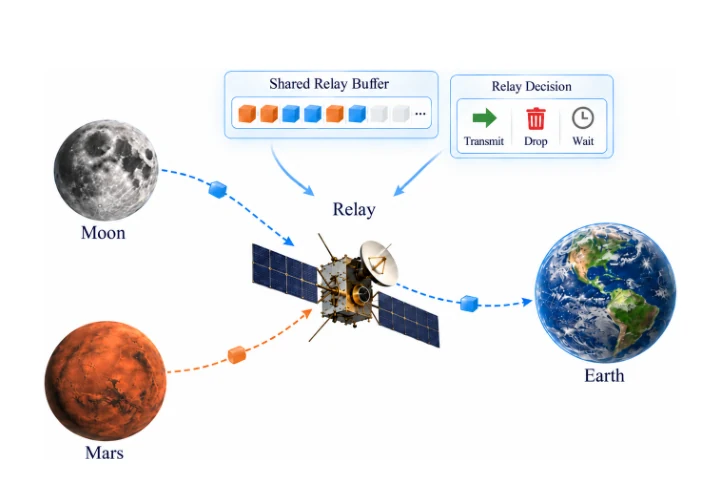
Protocol and flow-control design for links that are slow, shared or intermittent. The thread runs from measuring Age of Information on real TCP/IP and LoRa links, through application-layer forward error correction that holds peak age below a threshold, to goal-oriented transmission and freshness-driven satellite IoT access. Current work in the ERC-funded GO-SPACE project extends this to delay-tolerant and deep-space settings, where feedback is slow and contact windows are scheduled.
Age of InformationProtocol DesignForward Error CorrectionSatellite Communications
Representative works
-
2026
Conference
Goal-Oriented Bundle Management and Flow Control for Deep-Space Communications via Reinforcement Learning
77th International Astronautical Congress (IAC 2026), Antalya, Türkiye
-
2026
Preprint
ASTRA: Asynchronous Age-Aware Satellite Random Access via Mean-Field Control
arXiv preprint arXiv:2605.18282 [cs.NI]
-
2024
Preprint
A³L-FEC: Age-Aware Application Layer Forward Error Correction Flow Control
arXiv preprint arXiv:2410.05852 [cs.NI]
-
2023
Book Chapter
Age of Information in Practice
Chapter 12 in Age of Information: Foundations and Applications, eds. N. Pappas, M. A. Abd-Elmagid, B. Zhou, W. Saad and H. S. Dhillon
IoT & cyber-physical systems
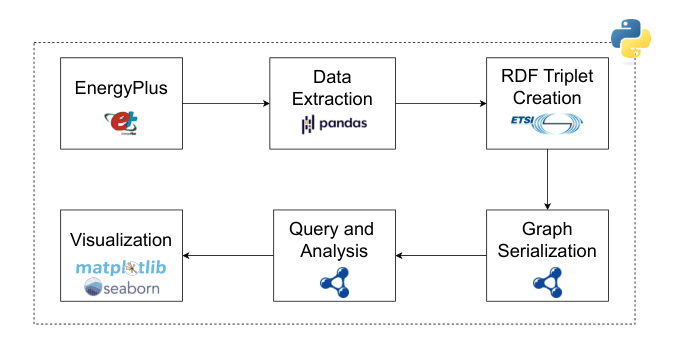
End-to-end IoT work: embedded nodes and firmware, LoRa/LoRaWAN and MQTT pipelines, gateways and edge processing, and the data platforms above them. Recent work covers environmental sensing platforms deployed in buildings, ontology-based smart-building semantics that make sensor data portable between tools, and digital twins that keep a model in step with the physical system it describes.
Representative works
-
2025
Conference
MipMap Digital Twin: A Scalable IoT-Based Framework for Smart Cities and Circular Economy
2025 33rd Signal Processing and Communications Applications Conference (SIU)
-
2025
Conference
Ontology-Driven Smart Building Semantics: An EnergyPlus-SAREF Approach
2025 33rd Signal Processing and Communications Applications Conference (SIU)
-
2025
Conference
IoT-Based Multi-Speed HVAC Control: Simulation Results and Testbed Development
2025 33rd Signal Processing and Communications Applications Conference (SIU)
-
2020
Conference
Towards AoI-aware Smart IoT Systems
2020 International Conference on Computing, Networking and Communications (ICNC)
AI, learning & control
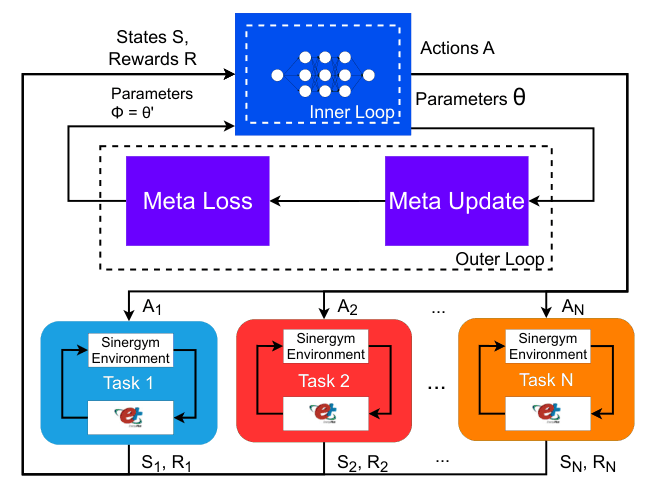
Learning used where a decision has to be made under constraints. Reinforcement learning for building climate control, meta-reinforcement learning for transferring a policy between climates rather than retraining from scratch, LSTM surrogate simulators that shorten the training loop, and edge inference placed on the device so that only the conclusion has to travel.
Representative works
-
2026
Conference
Goal-Oriented Bundle Management and Flow Control for Deep-Space Communications via Reinforcement Learning
77th International Astronautical Congress (IAC 2026), Antalya, Türkiye
-
2026
Conference
Analysis of Meta-Reinforcement Learning on Transfer Learning for HVAC Control
2026 34th Signal Processing and Communications Applications Conference (SIU)
-
2025
Conference
Analysis of Model-Agnostic Meta-Reinforcement Learning on Automated HVAC Control
2025 33rd Signal Processing and Communications Applications Conference (SIU)
-
2025
Conference
Accelerating Reinforcement Learning for HVAC Systems Using an LSTM-based Surrogate Simulator
2025 33rd Signal Processing and Communications Applications Conference (SIU)
Smart infrastructure & energy
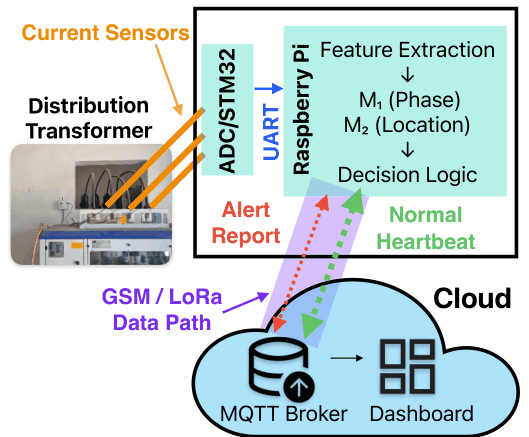
Instrumenting infrastructure that cannot easily be serviced. An AoI-aware fault-indicator device for electricity distribution, taken from hardware and embedded software through to pilot deployment in transformer substations, and an edge-AI detector that decides locally what is worth transmitting. Behind it sits a decade of energy-harvesting and wireless sensor network work on running nodes without batteries.
Representative works
-
2026
Conference
GridAI: Edge AI Smart Grid Fault Detection with Goal-Oriented Communication
Proceedings of the 24th Annual International Conference on Mobile Systems, Applications and Services Workshops (MobiSys Workshops '26), Cambridge, United Kingdom
-
2025
Conference
AoI-Driven IoT Fault Detection for Smart Grids
2025 33rd Signal Processing and Communications Applications Conference (SIU)
- 2014 Journal
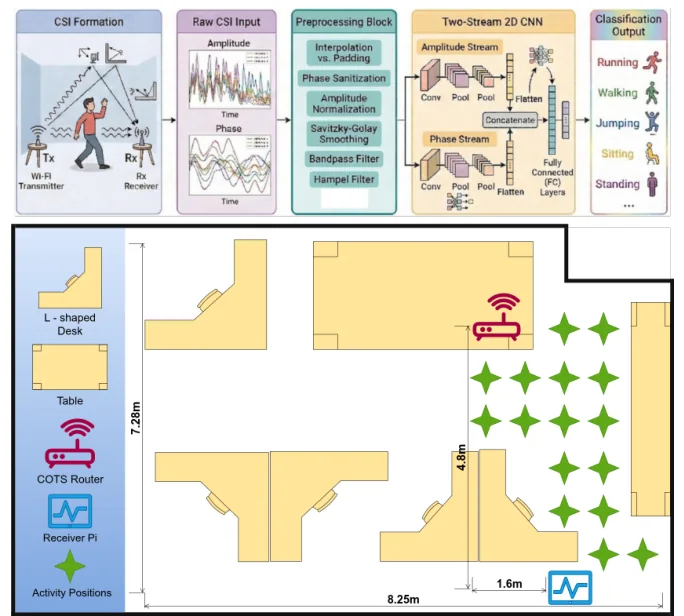
Wireless sensing
Reading the physical world from signals that are already there. Wi-Fi channel state information for device-free human activity recognition, including a synchronised acquisition pipeline, a public dataset and a controlled architecture benchmark; and earlier work on magnetic sensor networks for detecting, tracking and identifying ferromagnetic targets, alongside capacitive and dielectric material characterisation.
Wireless SensingHuman Activity RecognitionMagnetic SensingTarget Localization
Representative works
-
2026
Conference
REAL-CSI: Benchmarking DL Architectures for Wi-Fi CSI Human Activity Recognition
2026 34th Signal Processing and Communications Applications Conference (SIU)
-
2026
Conference
Evaluating the Impact of CSI Preprocessing on WiFi-Based Human Activity Recognition
2026 34th Signal Processing and Communications Applications Conference (SIU)
-
2015
Journal
Implementation of an Enhanced Target Localization and Identification Algorithm on a Magnetic WSN
IEICE Transactions on Communications
-
2012
Conference
Orthogonal Matching Pursuit for ferromagnetic target localization and identification
2012 20th Signal Processing and Communications Applications Conference (SIU)
Areas overlap by design: a smart-grid monitor is an IoT deployment, an edge-AI system and a networking problem at once. The counts above come straight from the topics recorded against each work, so a paper is counted in every area it genuinely belongs to.