REAL-CSI: Benchmarking DL Architectures for Wi-Fi CSI Human Activity Recognition
2026 34th Signal Processing and Communications Applications Conference (SIU)
Abstract
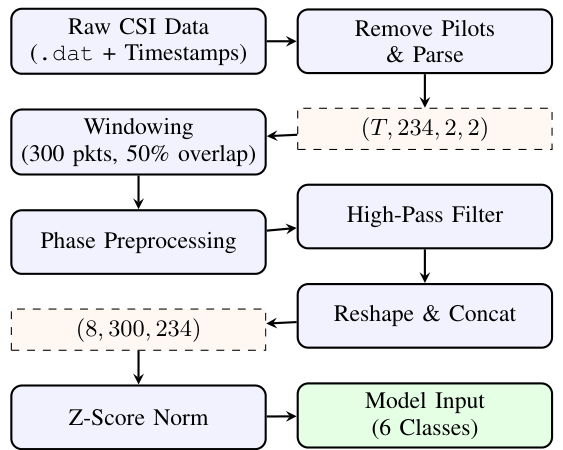
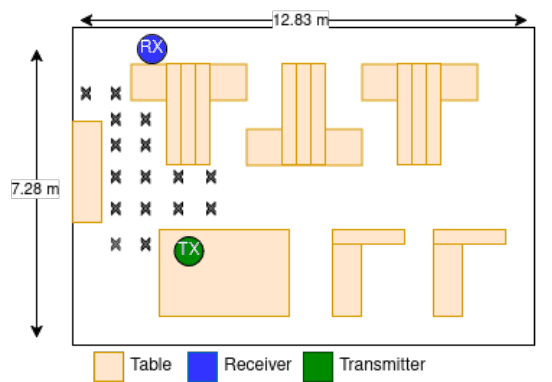
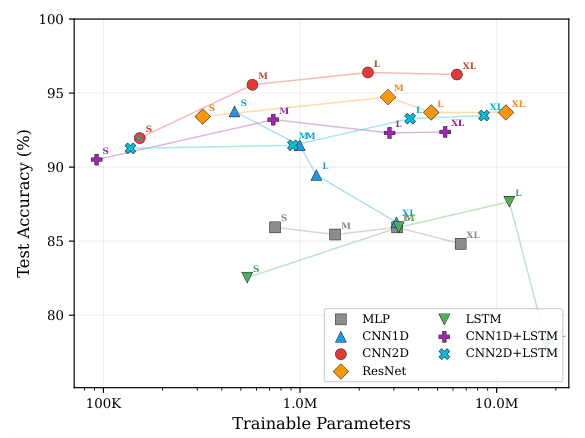
This paper presents the REAL-LAB CSI HAR Dataset, a publicly available Wi-Fi Channel State Information (CSI) dataset for human activity recognition (HAR), together with a controlled deep learning benchmark. We contribute to two key gaps in prior work: the lack of synchronized, balanced datasets and the limited understanding of how architecture and model capacity influence performance. Using a microsecond-synchronized acquisition pipeline, we collect a multi-class dataset and evaluate seven neural architectures across four parameter scales under a multi-seed protocol. The results show that architectural inductive bias dominates model capacity: 2D convolutional networks achieve the best accuracy-efficiency trade-off (96.40%), while larger models often yield diminishing or negative returns. These findings highlight that effective CSI-HAR design depends more on architecture than scale. The dataset and benchmark provide a reproducible foundation for future research.
Selected figures
Cite this work
E. B. Emiroğlu, Y. C. Çelik, S. Baghaee and I. Ulusoy, "REAL-CSI: Benchmarking DL Architectures for Wi-Fi CSI Human Activity Recognition," in 2026 34th Signal Processing and Communications Applications Conference (SIU), pp. 1-4, 2026. doi: 10.1109/SIU71813.2026.11636516.
@inproceedings{emirolu2026realcsi,
  author    = {Emiroğlu, Erdem Bera and Çelik, Yiğit Can and Baghaee, Sajjad and Ulusoy, Ilkay},
  title     = {REAL-CSI: Benchmarking DL Architectures for Wi-Fi CSI Human Activity Recognition},
  booktitle = {2026 34th Signal Processing and Communications Applications Conference (SIU)},
  pages     = {1-4},
  publisher = {IEEE},
  year      = {2026},
  doi       = {10.1109/SIU71813.2026.11636516},
  url       = {https://ieeexplore.ieee.org/abstract/document/11636516}
}