Evaluating the Impact of CSI Preprocessing on WiFi-Based Human Activity Recognition
2026 34th Signal Processing and Communications Applications Conference (SIU)
Abstract
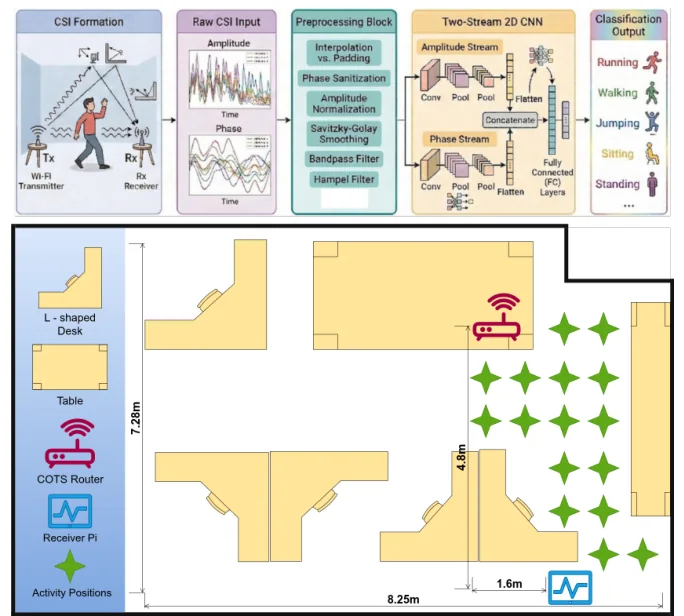
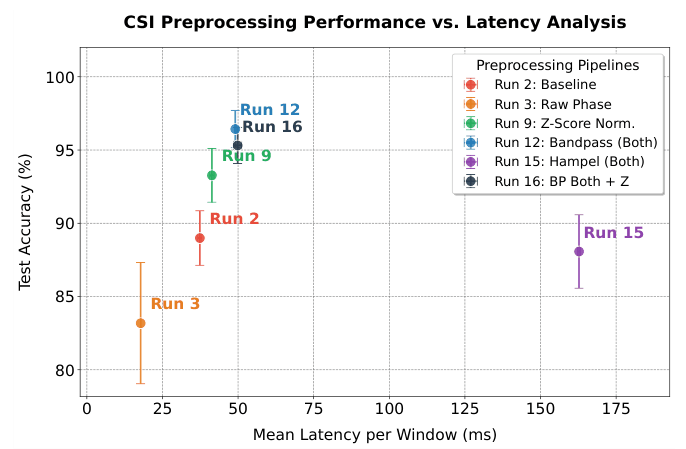
Wi-Fi Channel State Information (CSI) is a robust, privacy-preserving modality for Human Activity Recognition (HAR). Since raw CSI suffers from hardware desynchronizations and noise, preprocessing is vital. This study conducts an empirical ablation of CSI preprocessing using a fixed Two-Stream 2D CNN (Convolutional Neural Network) to quantify its impact on classification accuracy and latency. Results reveal that preprocessing, apart from architectural complexity, is the primary driver of the accuracy-latency trade-off. Computationally heavy methods like Hampel filtering introduce massive latency (>162 ms) without accuracy gains. In contrast, lightweight frequency-domain filtering consistently yields superior results. Specifically, dual-stream Butterworth bandpass filtering achieves 96.43% accuracy with only 49.08 ms latency. These findings demonstrate that isolating motion-relevant frequencies enables efficient, high-performance HAR suitable for real-time edge deployment.
Selected figures
Cite this work
Y. C. Çelik, E. B. Emiroğlu, S. Baghaee and İ. Ulusoy, "Evaluating the Impact of CSI Preprocessing on WiFi-Based Human Activity Recognition," in 2026 34th Signal Processing and Communications Applications Conference (SIU), pp. 1-4, 2026. doi: 10.1109/SIU71813.2026.11636472.
@inproceedings{elik2026evaluating,
  author    = {Çelik, Yiğit Can and Emiroğlu, Erdem Bera and Baghaee, Sajjad and Ulusoy, İlkay},
  title     = {Evaluating the Impact of CSI Preprocessing on WiFi-Based Human Activity Recognition},
  booktitle = {2026 34th Signal Processing and Communications Applications Conference (SIU)},
  pages     = {1-4},
  publisher = {IEEE},
  year      = {2026},
  doi       = {10.1109/SIU71813.2026.11636472},
  url       = {https://ieeexplore.ieee.org/abstract/document/11636472}
}